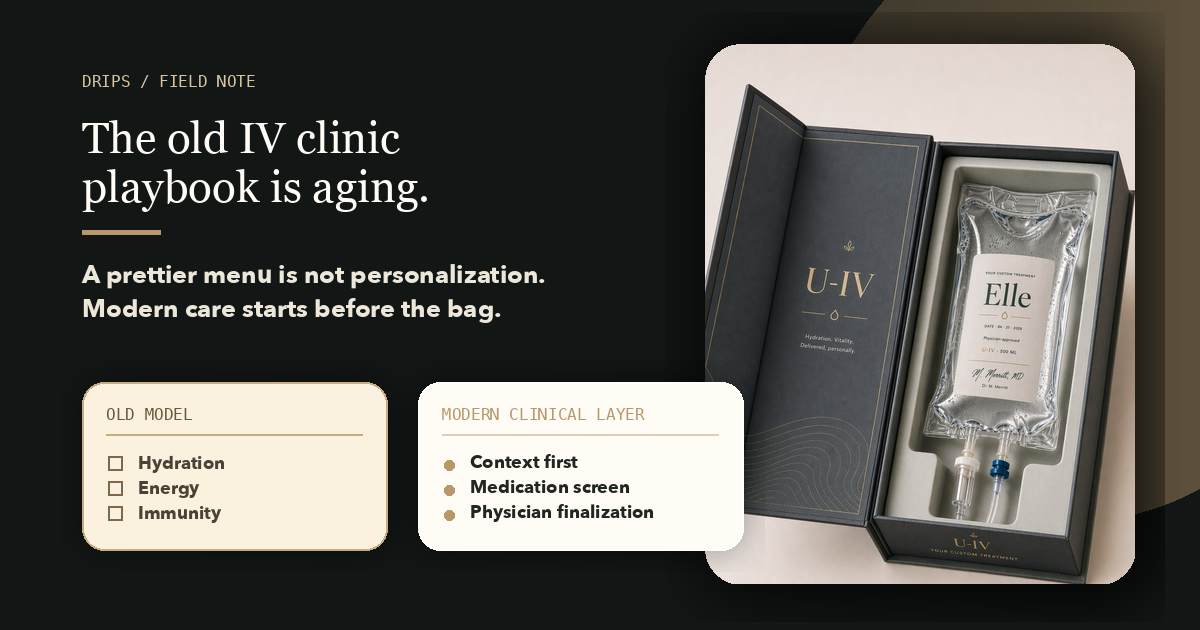
Mobile IV therapy has a modern surface. The booking flow is online. The bags or menu items go by names like hydration, energy, recovery, immunity, glow, focus, and performance.
But the operating playbook underneath much of the category is older than the branding suggests.
The best-known vitamin-infusion template, the Myers’ cocktail, traces back to Baltimore physician John Myers and the first IV vitamin treatments in the 1970s, according to the Merck Manual. That history matters. It means a large part of today’s IV wellness market is not built on a new precision-medicine model. It is often a decades-old formula, repackaged with better photography, smoother checkout, and broader claims.
At U-IV, we think that is the wrong direction. The future of mobile IV care is not more themed bags. It is better screening, better route selection, tighter claims, and physician-finalized care.
IV fluids are real medicine. That is exactly why the bar should be higher.
IV fluids have an important clinical role. Severe dehydration, electrolyte problems, inability to tolerate oral intake, perioperative care, and other medical situations can make intravenous fluids appropriate.
The mistake is turning that legitimate route into a lifestyle default.
For mild-to-moderate dehydration, StatPearls’ 2025 review of adult dehydration describes oral rehydration therapy as the preferred treatment because it is effective, safe, and less invasive than IV therapy. That does not mean an IV is never appropriate outside a hospital. It means the question should be asked every time: why is the bloodstream the right route for this person right now?
Most consumer IV menus do not start there. They start with the bag.
The category sells personalization, but often delivers menu selection.
A menu can feel personalized because the patient gets to choose. Immunity. Recovery. Glow. NAD+. Hangover. Performance.
But choice is not personalization.
Real personalization means understanding the patient before the product is finalized: goals, symptoms, medications, allergies, medical history, kidney and heart context, pregnancy status when relevant, blood pressure risk, and whether oral hydration or oral supplementation would be more appropriate.
That work is slower than a menu. It is also the work that makes IV care more serious.
A themed bag may be convenient. A physician-finalized plan is a different product.
The evidence gap is not a footnote.
The Merck Manual’s consumer and professional reviews are blunt: IV vitamin therapy is widely marketed for energy, immunity, stress, detox, skin health, and disease-related claims, but supporting evidence is limited, and there is no strong evidence that it treats disease in people without a deficiency.
A placebo-controlled pilot study of Myers’ cocktail for fibromyalgia found improvement in both the treatment and placebo groups, but no statistically significant difference in the primary outcome between them. That is not a reason to pretend no one ever feels better after a drip. It is a reason to stop marketing certainty before the evidence earns it.
The Federal Trade Commission made the same point in a different way in 2018, when it brought its first action targeting an IV cocktail marketer for allegedly unsupported claims involving serious diseases including cancer, multiple sclerosis, diabetes, fibromyalgia, and heart failure.
The lesson is simple: if a medical intervention is sold directly to consumers, the claims have to be disciplined.
Oversight is still uneven.
A 2025 JAMA Internal Medicine study looked at IV hydration spas across the United States and found a patchwork category. The researchers reviewed 255 facility websites and reported that all made beneficial claims, but only 2 cited sources for those claims. In a secret-shopper review of 87 facilities, only 24 required consultation with a licensed medical professional before treatment, while 75 recommended specific therapies for headache or cold symptoms. The same study found that 32 states had issued some form of IV hydration-spa guidance, but only 4 comprehensively addressed governance, prescriber credentials, dispensing practices, and compounding practices.
Those numbers should make the whole category pause.
An IV is not a smoothie. It crosses the skin barrier and goes directly into the bloodstream. That brings real obligations around sterility, dosing, screening, compounding, monitoring, and escalation.
The 50-year-old playbook has three problems.
First, it is formula-led. The patient is fit into a pre-existing bag instead of the plan being finalized from the patient’s context.
Second, it is route-casual. IV delivery is treated as inherently better because it feels stronger, faster, or more premium. Clinically, the route should be justified.
Third, it is claim-forward. The marketing often runs ahead of the evidence, especially around immunity, detox, energy, and broad disease-adjacent benefits.
A modern IV model has to invert that order: patient first, indication second, route third, product last.
What modern mobile IV care should look like.
A better model does not require pretending IV therapy is either magic or useless. It requires treating it like a clinical service.
That means:
- online intake that captures real context, not just a menu preference
- medication, allergy, condition, and contraindication screening before approval
- physician review before the plan is finalized
- licensed RN delivery and monitoring
- evidence-constrained claims
- saying no when IV therapy is not the right fit
- using convenience to improve access, not to lower the clinical bar
That is the gap U-IV is built around.
We are not trying to make the old drip-bar model look more luxurious. We are rebuilding the workflow around the patient: intake first, physician finalization second, RN delivery third.
The future is not more bags. It is better judgment.
Mobile IV therapy became popular because it solved a real convenience problem. People want care that comes to them, feels personal, and does not require a clinic waiting room.
But convenience cannot be the whole product. If the underlying clinical logic is still a 1970s vitamin-infusion template plus a modern checkout page, the category has not actually modernized.
The next version of IV care should be more personal, more careful, and more honest about what is known, what is uncertain, and when IV therapy makes sense.
That is the standard we are building toward at U-IV.
References
- Merck Manual. Intravenous Vitamin Therapy (Myers’ Cocktail).
- Taylor K, Tripathi A. Adult Dehydration. StatPearls. Updated March 5, 2025.
- Ali A, Njike VY, Northrup V, et al. Intravenous Micronutrient Therapy (Myers’ Cocktail) for Fibromyalgia: A Placebo-Controlled Pilot Study. Journal of Alternative and Complementary Medicine. 2009.
- Sivakumar A, Forman HP, Wang I, Lurie P, Ross JS. State Policies and Facility Practices of IV Hydration Spas in the US. JAMA Internal Medicine. 2025.
- U.S. Food and Drug Administration. FDA highlights concerns with compounding of drug products by medical offices and clinics under insanitary conditions. October 25, 2021.
- Federal Trade Commission. FTC Brings First-ever Action Targeting “iV Cocktail” Therapy Marketer. September 20, 2018.